
Keynote speaker, six honorees address social media, truth, civic engagement at the 2026 ‘Dangerous Dames of Dayton’ event
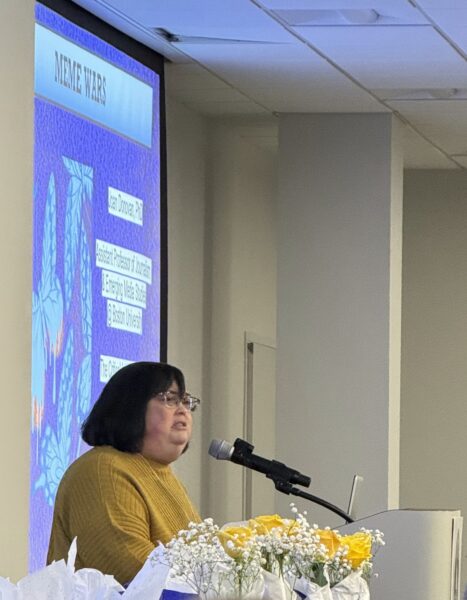
Keynote speaker Joan Donovan captivated the wall-to-wall crowd March 24, 2026, at the University of Dayton in Ohio as she outlined — citing evidence — how today’s online information environment makes it easy to create and spread false or manipulative content to undermine democracy in the United States.
The consequences are real, she said: Citizens in a democracy struggle to make informed decisions without accurate, reliable, trustworthy information.
Donovan headlined the 2026 Dangerous Dames of Dayton event, held at the university’s Daniel J. Curran Place, presented by the League of Women Voters (LWV) of the Greater Dayton Area. LWV is a nonpartisan, grassroots nonprofit dedicated to empowering every American to fully participate in our democracy.
“Dangerous dames” was coined in honor of the Dayton suffragists who marched and protested on the streets of Dayton and were deemed “dangerous to polite society.” These suffragists helped found the Dayton LWV chapter in 1920.
Education — and a warning — from Donovan
An assistant professor of journalism and emerging media studies at Boston University, Donovan is now finishing up a research project that’s examining generative AI as a national security threat. She is co-author of “Meme Wars: The Untold Story of the Online Battles Upending Democracy in America.”
At the Dayton event, Donovan began by defining disinformation as “the creation and distribution of intentionally false information for political ends.” She described how rumors and misleading memes can jump from digital screens into communities of real people, provoking threats, inciting fear and inflicting harm on our society and economy.
She urged attendees to look closely at what she calls the “ABCDs of media manipulation”: actors, behaviors, content and design.
Social media platforms are “amplification systems,” she said, and algorithms “turn up the volume on some ideas and turn down the volume on other ideas.
“There’s nothing neutral or objective about algorithmic judgment. It’s all programmed by humans, and they make decisions about what kinds of things you hear about.”
She gave this warning:
“Social media has become a tool of the powerful to dominate, harass and coerce vulnerable groups … if we do not acknowledge this shift, the free(dom) of speech will benefit only those who are already powerful.”
What citizens can do

Donovan challenged attendees to “get back to basics.”
Instead of relying on platforms as the foundation of democratic engagement, she urged attendees to return to “the project of democracy: not just voting, but all the in-betweens.”
Those include strengthening real-world civic organizations like LWV; investing in nonpartisan voter education; and inviting all people, especially younger generations, to meet and engage in person, build relationships and do civic, on-the-ground work, she said.
In other words, democracy today depends on citizens not only to understand how today’s online information environment works — but also to be informed and engaged, show up and hold institutions accountable, she said.
Celebrating the voices of six ‘dangerous dames’
In addition to learning from Donovan, attendees at the annual “slightly scandalous” Dayton event commended six honorees for doing courageous, sustained work for democracy, justice and community:
- Bonnie Beaman Rice, retired magistrate, community advocate and volunteer
- Sharon L. Davies, president and CEO, Charles F. Kettering Foundation
- Mary Sue Gmeiner, community activist
- Lucy Ann McKosky, community advocate and volunteer
- Elba “Alicia” Pagán, retired Ohio educator and current state director, League of United Latin American Citizens Ohio
- Sharon Rab, founder, Dayton Literary Peace Prize Foundation
Each honoree shared their gratitude for the recognition along with a few words of inspiration.
Some highlights:
Beaman Rice:
“There are (those) today who strive to rewrite history, to silence stories, to sever communities from their legacies. They know and fear that when we tell our stories, something remarkable happens. Our shared humanity rises up and connects us to one another.
“All of us in every culture have stories to tell that are filled with courage, resilience, heroes and yes — dangerous dames. When we silence a story, we extinguish a light. When we tell the story, we light one. … And that is the work of this league and the work of every dangerous person, including dames, to have a voice and to speak their truth.”
Davies:
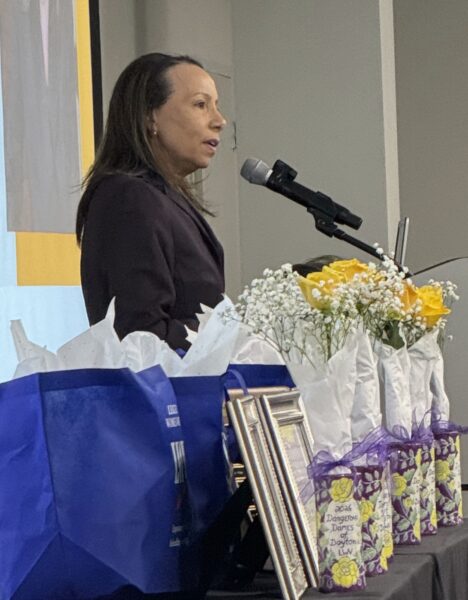
“The term ‘dangerous dame’ has evolved over time … to a more modern conception of a woman who is seen as a threat to the status quo, a woman who has an unsettling effect on others simply by knowing and owning her own power, and maybe also has a bit of a habit of refusing to play by the rules that were not designed with her in mind.
“Women in this room might want to be thought of as a threat to the status quo … we might still want to bend our energies toward writing new rules that are written with us in mind, are supportive of our success.
“There still is not a country on the face of the earth where men and women enjoy the same legal protections and equal status. … Last week at the United Nations meeting in New York … the United States was the only country in the world to vote against a document to strengthen legal protections for women and girls around the globe.”
Gmeiner:
“We all have our circles. We all live busy, responsible lives, and our circles include family, friends, co-workers … but I ask you to consider who might be outside the circle.
“I believe that we are called to always continue to widen our circles. Outside your circle might be a neighbor whose politics are different than yours, or perhaps it’s someone in church that you’ve never said hello to.
“Oftentimes, the people outside our circles are people with different race or ethnicity or economic circumstance, but we are called to hear their stories, and oftentimes, when we hear their stories, we change our perceptions.”
McKosky:
“Democracy is not a spectator sport … I hope that each of you will find a place where you can make the difference, because you can make the difference.
“None of us can do it all alone, but together, we can make this country once again a place of liberty and justice for all.”
Pagán:
“We support the democracy and the individual voice of each person in our community.
“We’re proud to stand alongside the League of Women Voters and all of our community partners who celebrate the song of community.
“If one voice is missing, the chorus of our humanity is diminished. And I ask that you remember those of us who cannot speak because it is too dangerous. We become the dangerous voices for those who are being diminished.
“I thank you all for the work that you do, and I pray that our democracy stands strong.”
Rab:
“When asked how literature leads to peace, I say I learned the answer from the writers, which is absolutely true.
“The path to peace begins with enlightenment, when we have those aha moments of things we have never considered before, and that aha moment leads to empathy, and empathy demands justice.
“In a just world, peace is possible.”
All proceeds from the Dangerous Dames event support the local league’s efforts to encourage active and informed participation in government, increase understanding of major public policy issues, and influence public policy through education and advocacy.