

Ethos and executive presence: How to get your audience to know, like and trust you
Your authority alone may earn you the right to speak.
But whether people believe you is earned as you speak.
Moment by moment, your audience is judging your character, credibility and executive presence — and deciding whether to trust you.
Aristotle gave us a practical framework to shape those perceptions. Here’s how to use it.

How to get your audience to know, like and trust you may seem like an urgent question for public speakers in modern times, as you face skepticism, cynicism and fractured attention, and strive for executive presence.
But in truth?
The Greek philosopher Aristotle helped public speakers address this very same question in ancient times, around 350 B.C.E., long before the term executive presence was ever used.
Aristotle spelled out his answers clearly in “Rhetoric,” his three-book series on the art of persuasion. In it, Aristotle outlined persuasion’s three modes:
- Ethos — the speaker’s character or credibility (which inspires trust)
- Logos — logic or reasoning
- Pathos — emotion
This post focuses solely on ethos since many speakers today tend to overlook its importance in persuading audiences — even though Aristotle elevated ethos above both logos and pathos when he said this:
It is not true, as some writers assume … that the personal goodness revealed by the speaker contributes nothing to his power of persuasion; on the contrary, his character may almost be called the most effective means of persuasion he possesses.
Aristotle also said:
Persuasion is achieved by the speaker’s personal character when the speech is so spoken as to make us think him credible.
We believe good men more fully and more readily than others: this is true generally whatever the question is, and absolutely true where exact certainty is impossible and opinions are divided.
This kind of persuasion … should be achieved by what the speaker says, not by what people think of his character before he begins to speak.
In other words:
- Based on what the speaker says, the audience perceives and then judges the speaker’s character, deciding for themselves whether that speaker is “good” — i.e., credible.
- An audience that deems a speaker as credible is more easily persuaded than an audience that decides just the opposite.
Character as ‘goodness’
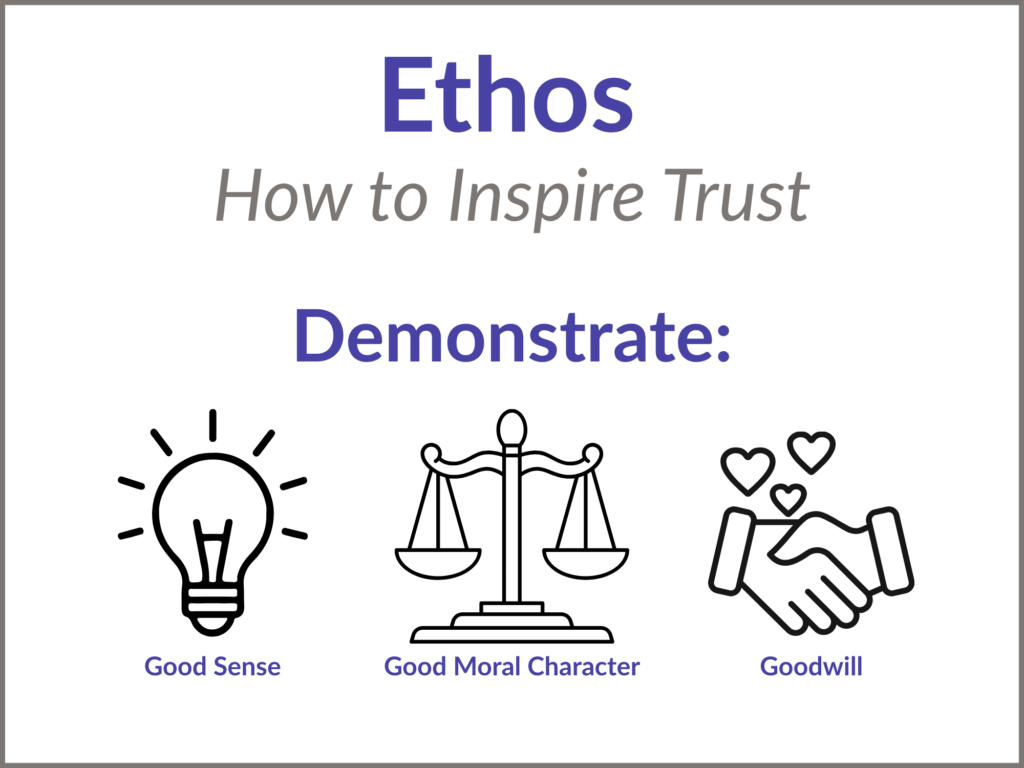
Aristotle broke ethos down further when he explained the three elements of “goodness” that inspire confidence in a speaker’s character:
- Good sense
- Good moral character
- Goodwill
A speaker who demonstrates good sense, good moral character and goodwill can help an audience believe something even without any proof.
And further, Aristotle said:
Anyone who is thought to have all three of these good qualities will inspire trust in his audience.
And inspiring trust, of course, is the holy grail for public speakers who want to persuade: to change the way an audience thinks or behaves.
Ethos in action: The foundation of executive presence
Here’s what is true:
Your authority — as revealed by your credentials, title or list of accomplishments — may give you the opportunity to speak.
But it is your ethos — your character or credibility — that earns you the chance to be known, liked and trusted.
As a speaker, if revealing your character is your most effective means of persuasion, as Aristotle says, you must be able to master it as you build executive presence.
Here are some practical ideas, with questions for you to consider, so you can decide whether you have effectively applied ethos by demonstrating good sense, good moral character and goodwill in an upcoming speech or presentation.
1 – How to demonstrate good sense (that you understand reality)
Show you understand what the audience is facing

- Have you spoken the truth about the audience’s worldview: how they think?
- Have you identified the audience’s top pressures, priorities or conditions shaping their current environment?
- Have you gone deeper into one or more specific challenges the audience is working through so they know you truly “get them”?
Show you can turn ideas into practices
- Have you stated how your idea will change what the audience does day to day, specifically?
- Have you painted a clear picture so the audience can see how your idea works in action to produce real results?
- If the audience accepts your idea today, do they know the first step to take tomorrow?
Show you recognize that obstacles exist
- Have you identified the boundaries, gaps, constraints, hurdles, risks, tradeoffs and unknowns associated with your idea?
- Have you explained these obstacles clearly and realistically?
- Are you willing to admit you do not have all the answers?
2 – How to demonstrate good moral character (that you are honest and principled)
Show your true agenda

- Have you made it clear precisely why you are speaking?
- Have you explained why this issue matters to you, either personally or professionally?
- Have you stated what you hope will happen after you share your idea and message?
Show your fairness toward others
- Have you demonstrated humility by generously recognizing other people who have contributed to the work you are discussing?
- Have you been clear about the sources of certain ideas and data you have shared?
- Have you noted any support, resources or conditions present that made your work possible?
Show your principles
- Do you address any difficult truths, such as problems or past mistakes, with honesty?
- Do you connect your ideas to the same values and responsibilities the audience shares with you?
- Do you make it clear how your decisions and actions align with your beliefs?
3 – How to demonstrate goodwill (that you are on the audience’s side)
Show you care by recognizing the audience

- Have you shared what you genuinely admire about the audience?
- Have you praised the audience in a specific, authentic way to express your appreciation and build rapport?
- Have you given a concrete example of a challenge the audience has overcome, a milestone they have reached or a result they’ve achieved?
Show you care by explaining why the idea matters to the audience
- Have you connected the idea to what the audience cares about most — their work, their teams, their customers, their results or something else?
- Have you identified precisely how the idea will affect people in the audience — and clearly acknowledged those impacts?
- Have you explained exactly what the audience will gain, avoid or improve as a result of this idea?
Show you care by involving the audience as a partner
- Have you used language proving that you and the audience are working in tandem — i.e., words such as “we,” “us,” “our” and “together”?
- Have you clearly identified the specific role the audience plays in bringing the idea to life?
- Have you made it clear to the audience that success depends on a shared effort and not just action on their part?
Here’s your takeaway on ethos and executive presence
Before your next speech or presentation, don’t focus only on logos, your logical argument, and pathos, the emotion behind your storytelling.
Instead, give ethos its due.
Focus as well on shaping what your audience will perceive and then decide about you: your character and your credibility.
Because while you’re speaking, your audience is asking:
- Do you understand my reality?
- Can I be sure you are honest and principled?
- Are you on my side?
And they’re answering those questions not based on your authority, as revealed by your credentials, title or list of accomplishments.
Instead, they’re answering those questions based on what you say, moment by moment.
So as you prepare your next speech or presentation, use this simple framework, inspired by Aristotle, as a double check on ethos and executive presence:
- Where do you demonstrate good sense, so the audience is sure you understand their reality?
- Where do you demonstrate good moral character, so the audience trusts your integrity?
- Where do you demonstrate goodwill, so the audience can be sure you’re on their side?
Remember:
You can’t become known, liked and trusted simply by saying you’re credible.
You earn it by how you choose to communicate with your audience.
When your audience gets to know, like and trust you based on what you say, they’re far more likely to believe you.
And far more likely to change the way they think or behave.
Want to learn more about persuasion in public speaking?
Work with Teresa Zumwald: a 21-time winner of the Cicero Speechwriting Awards who delivers custom speechwriting services, plus executive speech coaching, executive communication, and speaking and training.
She can help you learn how to speak like a leader and AIM for Impact every time you speak in public.